
 4 months ago
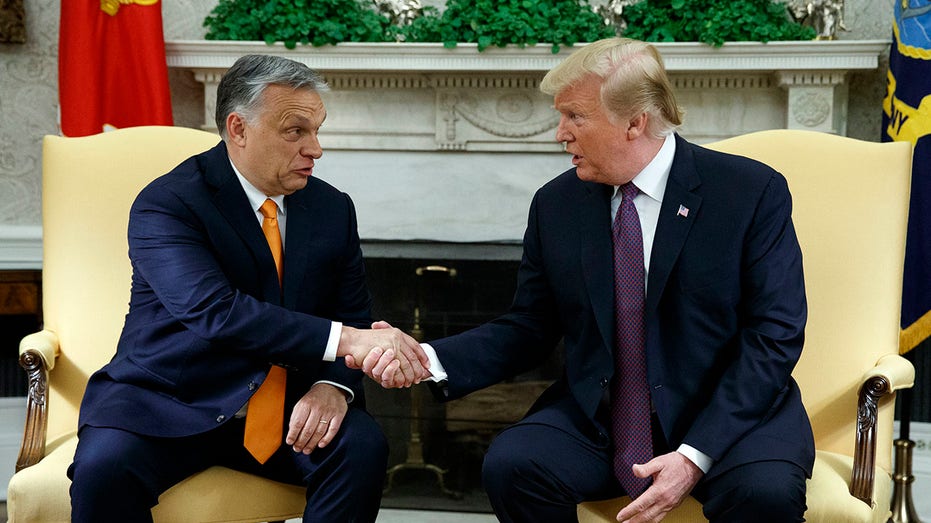
The U.S. and Europe are watching closely as Hungarians turned out in record numbers to vote Sunday in a high-stakes election that sets up Trump ally, Prime Minister Viktor Orbán, against his former political ally, Péter Magyar.
Trailing in the opinion polls, Orbán’s received a major boost earlier this week when Vice President JD Vance visited the country, making clear what the administration’s position was on the importance of having a pro-U.S. candidate in the heart of Europe, as so many of its continental allies have proven lackluster, most notably for a lack of help in the war against Iran.
In his remarks, Vance made clear why he was there. "The reason why we're doing it is because we thought there was so much garbage happening against Viktor in this election that we had to show that there are actually a lot of people and a lot of friends across the world who recognize that Viktor and his government are doing a good job, and they're important partners for peace," he said at the Mathias Corvinus Collegium, a private university in Budapest, the capital of Hungary. "That's why we're here, but ultimately the Hungarian people are going to be sovereigns because that's how it should be."
TRUMP CALLS INTO VANCE-ORBAN HUNGARY EVENT: 'MY KIND OF PEOPLE'
Following Vance’s return to the U.S., President Donald Trump weighed in on Truth Social Friday: "My Administration stands ready to use the full economic might of the United States to strengthen Hungary’s Economy, as we have done for our great allies in the past, if Prime Minister Viktor Orbán and the Hungarian People ever need it. We are excited to invest in the future prosperity that will be generated by Orbán’s continued leadership!"
Beloved by many older and more rural Hungarians and reviled by detractors, Orbán has emerged as the country’s most consequential leader since its transition to democracy at the end of the Cold War. Still, the election campaign has become intense.
Orbán’s strained relationship with the European Union comes from his positioning on Russia’s war against Ukraine, his country’s firm support of Israel and his hard stance on not accepting migrants, which led to EU financial sanctions for his refusal to open the country's border to foreigners.
During the 16-year Orbán government, the Hungarian economy has grown relatively quickly for an EU country. The country’s GDP per capita (what the average person earns annually) rose to nearly $17,000 last year, up from approximately $12,000 in 2014, according to Trading Economics data. However, it’s not all good. Inflation has recently been relatively high at an annual rate of 4.9%, and business sentiment has been consistently negative since Aug. 2022.
TRUMP SAYS HUNGARY'S BORDER STANCE KEEPS CRIME DOWN, SAYS EUROPE 'FLOODING' WITH MIGRANTS
The poll of polls shows Magyar’s Tisza party with 50% of the vote and Orbán’s Fidesz party behind at 39% as of April 9, according to Politico. Magyar now poses the largest electoral threat to Orbán since 2010.
"The polls are going well for the opposition," Daniel Wood, portfolio manager at William Blair Investment Management, told Fox News Digital. "If the opposition wins, there’s a chance that the EU unlocks the frozen funds, which are around 7% of the GDP."
Speaking to reporters outside a polling station Sunday, Orbán, 62, said the campaign had been "a great national moment on our side" and thanked activists and supporters for their work. "I’m here to win," the Associated Press reported.
In an interview earlier in the week, Péter Magyar complained the EU’s longest-serving leader has led the country on a "180-degree turn" in recent years, endangering its Western orientation while cozying up to Moscow. Yet despite that drift, "Hungarians still see that Hungary’s peace and development are guaranteed by membership of the European Union and NATO," Magyar said. "I think this really will be a referendum on our country’s place in the world," he told the Associated Press.
Results are expected later this afternoon.
The Associated Press contributed to this report.






 English (US)