
 3 months ago
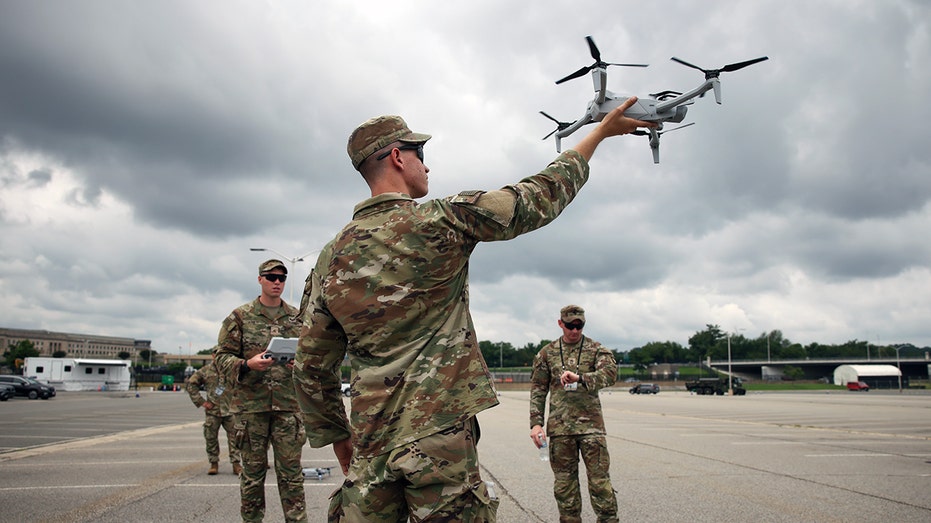
The Pentagon is seeking roughly $55 billion for drone and autonomous warfare programs in its fiscal year 2027 budget, as battlefield conflicts from the Middle East to Ukraine expose a growing problem: cheap drones are increasingly able to overwhelm costly U.S. defenses.
The funding request, a dramatic surge from roughly $225 million a year earlier, signals a major shift in how the U.S. military plans to fight future wars, accelerating a move toward large numbers of lower-cost, AI-enabled systems.
The funding, tied to a little-known Pentagon office known as the Defense Autonomous Warfare Group, represents a broad category spanning multiple programs across the services — including procurement, research, training and sustainment — rather than a single standalone weapons system.
War Secretary Pete Hegseth is expected to face questions on the budget when he testifies before Congress Thursday, as lawmakers begin weighing what would be the largest Pentagon request in modern history. The administration is seeking roughly $1.5 trillion in national defense spending for fiscal year 2027 — a more than 40% increase from the prior year and the biggest single-year jump in decades — with major investments in drones, missile defense and next-generation warfare systems at the center of the request.
At the center of the shift is a change in doctrine: moving away from a force built around a small number of high-cost platforms toward one designed to deploy large numbers of cheaper systems capable of operating in coordinated groups, often referred to as drone swarms.
In recent confrontations in the Middle East, Iranian drone and missile attacks have forced U.S. and allied defenses to respond to waves of low-cost aerial threats, exposing what defense officials describe as a growing "math problem" — firing expensive interceptors at far cheaper drones.
In one recent engagement, Gulf air defenses tracked dozens of incoming drones alongside ballistic missiles, intercepting many but underscoring how clustered attacks can strain even advanced systems.
US DRAINS CRITICAL MISSILE STOCKPILES IN IRAN WAR AS YEARSLONG REBUILD LOOMS
The same dynamic has played out in Ukraine, where Russia has used Iranian-designed drones in large numbers to pressure air defenses, forcing defenders to expend significant resources to stop relatively inexpensive systems.
Those battlefield lessons are now shaping Pentagon planning, driving a push toward systems designed not just to defend against drone swarms, but to deploy them at scale.
Unlike traditional unmanned systems operated individually, the Pentagon’s new approach emphasizes networks of drones designed to operate together, sharing data and coordinating movements in real time. In theory, such swarms can overwhelm defenses by attacking from multiple directions at once, forcing adversaries to track and respond to dozens — or even hundreds — of targets simultaneously.
Pentagon initiatives are already moving beyond experimentation, with programs aimed at fielding coordinated drone groups in the near term and allowing a single operator to direct multiple systems simultaneously.
While the concept has been tested in limited scenarios, fully autonomous coordination at scale remains a technical challenge, particularly in contested environments where communications can be disrupted.
The funding supports a wide range of systems across air, land and sea, from small, expendable aerial drones to autonomous surface vessels and ground-based platforms, along with the software and communications networks needed to link them together.
Officials increasingly have emphasized rapid production and lower-cost designs, aiming to field large numbers of systems quickly rather than relying on smaller fleets of more expensive platforms. Much of that effort is expected to draw on commercial technology as the Pentagon seeks to accelerate development timelines.
The shift reflects a broader change in warfare, where industrial capacity and the ability to produce large numbers of systems quickly are becoming as important as technological superiority.
Military planners also have warned that adversaries are investing heavily in similar capabilities.
ALLIES RUSH THOUSANDS OF DRONES TO UKRAINE AS RUSSIA UNLEASHES DEADLY MISSILE BARRAGES
China has demonstrated large-scale drone swarm operations involving hundreds of coordinated systems, highlighting the pace of global competition in autonomous warfare and raising concerns about how such capabilities could be used in a future conflict.
On the battlefield, adversaries are continuing to adapt. Russian forces have begun experimenting with larger "carrier" drones capable of launching smaller attack drones mid-flight, extending range and complicating air defenses, while Iran has refined the use of mass-produced strike drones to overwhelm defenses through sustained attacks.
At the same time, the Pentagon and its allies are racing to develop countermeasures designed to match that scale.
Layered defenses now include a mix of traditional interceptors, electronic warfare tools and emerging systems such as interceptor drones, aimed at addressing the cost imbalance exposed by recent conflicts. The goal is to build defenses capable of absorbing large waves of incoming threats without relying solely on high-cost missiles.
Despite the scale of the investment, questions remain about how quickly the Pentagon can field these capabilities at scale. Previous efforts to accelerate drone production have faced delays, and integrating large numbers of autonomous systems into existing military structures presents technical and operational challenges.









 English (US)