
 8 months ago
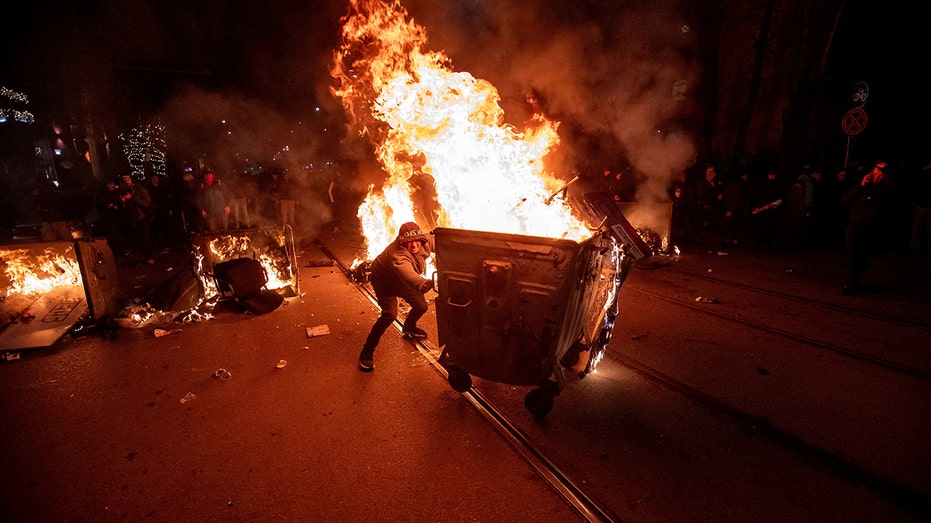
Bulgaria’s government withdrew an unpopular 2026 draft budget after tens of thousands of angry people took to the streets in the capital, Sofia, and other cities across the country.
The protests have been led mostly by young Bulgarians who claim the government is concealing widespread corruption. Business groups and members of the opposition also say the draft budget would harm Bulgaria’s economy just before it's set to join the Eurozone in early 2026.
"Gen Z took to the streets because they want to stay in Bulgaria, but they want a renewed, different, corruption-free Bulgaria," Daniel Lorer, member of Bulgaria’s parliament, told Fox News Digital.
BULGARIA'S SUPPORT FOR UKRAINE'S NATO MEMBERSHIP GROWS STRONGER DURING ZELENSKYY'S VISIT
"They want reforms. The government refused to listen. The budget it proposed simply extended all its previous policies, funded through higher taxes, social security contributions and more debt," Lorer added.
As the protests continued, Bulgaria’s government, led by Prime Minister Rosen Zhelyazkov, eventually backed down, vowing to drop the most divisive elements of the budget, including tax and social security increases.
The prime minister said a new budget will be proposed at a later date.
"The government saw what the citizens… protesters had to say… I support these people who protest for more rights, more democracy, more justice. We believe that the protest is not so much political, but more of a social, human side, in search of more dialogue, more tolerance and more harmony in social relations," Prime Minister Zhelyazkov said at a press conference.
BULGARIA IMPOSES EU ENTRY BAN ON 2 SUSPECTED RUSSIAN SPIES
"This is a visible protest of young people, young people who are looking for their place in the future of Bulgaria, which we are obliged to hear, and we are obliged to do what is necessary to be secured with the funds that the country has," Zhelyazkov added.
The protests were mostly peaceful. However, some masked protesters clashed with police after attacking offices of the ruling party in Sofia.
Political stability in an EU country, one with a longstanding history with Russia, is ripe for Moscow’s usual tricks of intervening in the domestic affairs of its former communist bloc allies.
"Russia is always glad to stir unrest. Anything that upsets the democratic process in any EU country is welcome, and even more so in Eastern Europe, their former sphere of influence," Lorer said.
Bulgarian President Rumen Radev, who holds a largely ceremonial position, sided with the opposition and opposed the budget, calling for the resignation of the government and early elections.
The move could risk political gridlock and weaken Bulgaria’s alliance with NATO allies and the EU, Ruslan Stefanov, director for the Center for the Study of Democracy in Sofia, told Fox News Digital.
"Radev, who echoes Kremlin talking points and opposes the Euro, could still sabotage the process despite it being legally irreversible. This is a volatile mix that threatens stability and could invite more unwelcome Russian meddling," Stefanov said.
Bulgaria, along with Romania, is set to join the Eurozone in January 2026. While joining the Eurozone is seen as a major step in Bulgaria’s political and economic development, the adoption of the currency is unpopular in large segments of society, as fears of inflation and the cost of living hamper the livelihoods of everyday Bulgarians.
FARMERS FLOOD BULGARIA'S CAPITAL PROTESTING EU REGULATIONS, HIGH ENERGY COSTS
Bulgaria, which is the poorest nation in the European Union, joined the EU in 2007 and formally began the process of joining the Eurozone in 2018. The Lev, Bulgaria’s currency, was included in the European Exchange Rate Mechanism in July 2020.
Since announcing that the country will join the monetary union, skepticism has abounded, and many Bulgarians are not convinced that their economic prospects will improve once they are part of the union.
Many experts and observers have concluded that Russia has been behind a persistent social media campaign to stoke opposition and sow doubt and confusion as Bulgaria’s accession date draws near.


 English (US)