
 3 months ago
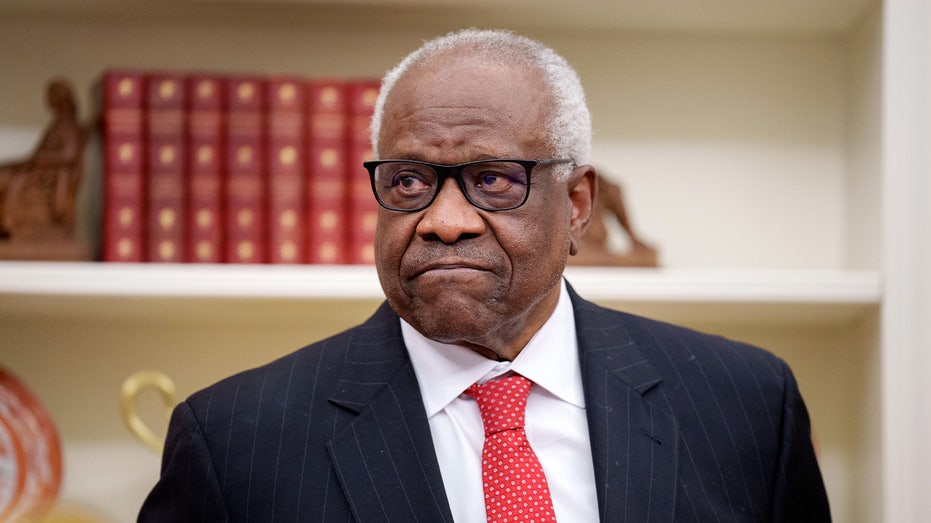
Supreme Court Justice Clarence Thomas ripped the court's decision blocking President Donald Trump’s use of an emergency law to impose sweeping tariffs on trading partners, calling it a fundamental misread of both the governing statute and the Constitution’s separation of powers.
"As (Kavanaugh) explains, the Court’s decision … cannot be justified as a matter of statutory interpretation. Congress authorized the President to ‘regulate ... importation,’" Thomas wrote in his dissent. "Throughout American history, the authority to ‘regulate importation’ has been understood to include the authority to impose duties on imports."
The court invalidated Trump's use of an emergency law to impose tariffs in a 6–3 decision Friday morning after weeks of Trump championing that the court should rule in his favor as part of his larger effort to boost the economy, jobs and bring down costs for Americans. Thomas and Justice Samuel Alito joined Justice Brett Kavanaugh in dissenting from the ruling, with Thomas also offering his own separate dissent.
The majority of the court ruled Friday that the International Emergency Economic Powers Act does not authorize the president, even after declaring a national emergency, to impose tariffs — and that Congress did not speak clearly enough to transfer its tariff-and-tax power to the executive branch.
TRUMP RESPONDS TO SUPREME COURT RULING REJECTING SWEEPING TARIFFS POWERS: 'A DISGRACE'
The International Emergency Economic Powers Act (IEEPA) is a 1977 law that allows the president, after declaring a national emergency in response to foreign threats, to regulate or block certain economic transactions and property interests, such as by imposing sanctions.
"The president asserts the extraordinary power to unilaterally impose tariffs of unlimited amount, duration, and scope," Supreme Court Justice John Roberts wrote for the court. "In light of the breadth, history, and constitutional context of that asserted authority, he must identify clear congressional authorization to exercise it."
TRUMP'S TARIFF REVENUES HIT RECORD HIGHS AS SUPREME COURT DEALS MAJOR BLOW
In his dissent, Thomas argued that nondelegation doctrine is a narrow constraint, saying a line is crossed only when Congress delegates "core" power to make rules triggering deprivations of "life, liberty, or property" — not "from delegating other kinds of power," such as tariffs.
The nondelegation doctrine forbids Congress from delegating core legislative power to the president.
"As I suggested over a decade ago, the nondelegation doctrine does not apply to ‘a delegation of power to make rules governing private conduct in the area of foreign trade,’ including rules imposing duties on imports," Thomas wrote. "Therefore, to the extent that the Court relies on ‘separation of powers principles’ to rule against the President is mistaken."
SUPREME COURT RULES ON TRUMP TARIFFS IN MAJOR TEST OF EXECUTIVE BRANCH POWERS
Thomas pointed to President Nixon’s 1971 import surcharge as a real-world test case that was later upheld in United States v. Yoshida Int’l under IEEPA’s predecessor statute, the Trading with the Enemy Act.
Nixon announced a 10% across-the-board import surcharge on foreign nations in 1971, with the U.S. Court of Customs and Patent Appeals upholding the policy under the same "regulate ... importation" language in 1975.
"The meaning of that phrase was beyond doubt by the time that Congress enacted this statute, shortly after President Nixon’s highly publicized duties on imports were upheld based on identical language," Thomas wrote.
"The statute that the President relied on therefore authorized him to impose the duties on imports at issue in these cases," Thomas wrote, adding that Kavanaugh "makes clear that the Court errs in concluding otherwise."
Trump unveiled his tariff policies in April 2025, which have come with repeatedly updated deals with foreign nations, as a tool to bring parity to U.S. trade policy and encourage businesses to open up shop on U.S. soil as part of an American manufacturing renaissance to boost the job market and the economy.
Trump, in recent months, has repeatedly promoted that the Supreme Court rule in his favor, warning just Thursday during a trip to a steel factory in Georgia that "without tariffs, this country would be in such trouble right now."
The president held a press conference shortly after the decision on Friday, announcing a 10% global tariff, while underscoring that the "Supreme Court did not overrule tariffs," but "merely overruled a particular use of IEEPA tariffs."



 English (US)